



 Genes
Genes
 Oligo Pools
 NGS
NGS
 Variant Libraries
 Antibodies
 IVDR Solutions




Twist Bioscience HQ
681 Gateway Blvd
South San Francisco, CA 94080
NGS Kits
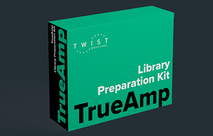
Twist TrueAmp Library Preparation Kit
The TrueAmp Library Prepration Kit supports a broad range of DNA input amounts, from as low as 100 pg up to 1 µg. This flexibility enables reliable library preparation across low-input and high-input sample types.
The TrueAmp Library Preparation Kit is designed for flexible DNA library construction across a wide range of sample types and input amounts. It supports an integrated workflow where fragmentation, end repair, and dA-tailing are performed in a single enzyme mix, simplifying the overall process.
The kit performs robustly across diverse DNA inputs, including FFPE samples or samples with varying GC content and is compatible with DNA in common storage buffers such as TE, Tris-HCl, or water.
It also enables consistent and reliable fragmentation using a single standardized protocol, while also allowing users to tune insert size by adjusting incubation time or temperature. The streamlined workflow can be completed in approximately 3 hours, with less than 15 minutes of hands-on time, and is designed to maximize library yield through high reaction efficiency and minimal sample loss.
Yes, fragmented and end-prepped DNA can be safely stored at either 4 °C or -20 °C (e.g., overnight) prior to ligation without any appreciable impact on library preparation performance as compared to samples processed immediately. This has been validated across technical replicates (n=3), where samples were stored under these conditions before ligation and showed consistent results.
Yes. The TrueAmp reagents have been tested through up to four freeze-thaw cycles with no observed impact on performance. These studies were conducted over multiple days to reflect typical laboratory use. As a best practice, repeated freeze–thaw cycles should still be minimized when possible.
Yes, contaminants such as salts, EDTA, ethanol, detergents, and extraction reagent carryover can impact enzymatic fragmentation. These may either inhibit or enhance enzyme activity, leading to inconsistent or shifted fragment sizes.
In some cases, fragmentation can be tuned by adjusting incubation time or temperature to compensate. However, if inhibitors significantly disrupt enzyme activity and no library is generated, we recommend performing an additional DNA cleanup before library preparation.
Yes. The TrueAmp fragmentation chemistry is broadly compatible with a range of double-stranded DNA inputs, including genomic DNA (gDNA), plasmids, and PCR-derived amplicons. Under consistent reaction conditions, high-quality DNA substrates, regardless of origin, typically yield comparable fragment size distributions, indicating minimal sequence or topology-dependent bias.
During development, fragmentation performance was evaluated using DNA ladders spanning a wide range of fragment sizes. This study demonstrates that the enzymatic fragmentation preferentially processes larger DNA molecules while maintaining representation of shorter fragments, resulting in a controlled size distribution without significant loss of diversity across the input population.
No, the TrueAmp Library Preparation Kit is not compatible with bisulfite conversion or EM-seq workflows. The enzymatic steps in the TrueAmp Library Preparation workflow include DNA repair, which can alter or remove native methylation signatures.
For methylation-sensitive applications such as bisulfite or EM-seq, we recommend using mechanical shearing (e.g., sonication) followed by the Twist cfDNA Library Preparation Kit, which is better suited for preserving methylation information.
Yes, the TrueAmp Library Preparation Kit is compatible with liquid handling automation platforms such as Hamilton systems. The streamlined workflow, reduced number of steps, and minimal hands-on time make it well suited for automation. Minor optimization (e.g., mixing, bead handling, or liquid classes) may be required depending on the platform and configuration.
Yes, the TrueAmp Library Preparation Kit performs well with degraded and FFPE-derived DNA. The workflow includes DNA repair activity, which can help restore damaged bases commonly found in FFPE samples.
As a result, users often observe improved library yield and recovery compared to workflows without repair. Some optimization (e.g., fragmentation time, PCR cycles) may be required depending on sample quality.
The TrueAmp Library Preparation Kit is not recommended for cfDNA workflows. Since cfDNA is already fragmented, the enzymatic fragmentation step is unnecessary. While it is possible to skip fragmentation and proceed with end repair and dA-tailing, the one-pot workflow may not deliver optimal conversion efficiency for these short fragments.
For best performance and highest library conversion from cfDNA, we recommend using the Twist cfDNA Library Preparation Kit, which is specifically optimized for cell-free DNA.
Yes, the TrueAmp Library Preparation Kit is well suited for targeted enrichment workflows, including hybrid capture applications. It generates high library yields and promotes uniform molecule conversion, which supports efficient and consistent downstream target capture performance.
The insert is the DNA of interest generated during fragmentation. The insert size refers to the length of this DNA region. The fragment (or sequencing fragment/library) includes the insert plus the sequencing adapters ligated to both ends. Therefore, fragment size = insert size + adapter sequences. Traditional adapter sequences are roughly 65-70nt long but dependent on the presence of UMIs or length of indexes. In paired-end sequencing, reads are generated from both ends of the insert. If the insert is longer than the combined read length, a portion in the middle remains unsequenced. If the insert is shorter, reads may overlap or extend into adapter sequences.
No. The enzymatic fragmentation chemistry is designed to produce consistent fragment sizes across the recommended input range, so fragmentation time and temperature do not need to be adjusted based on DNA mass.
Under the same conditions, samples with similar DNA quality ranging from 0.1 ng to 500 ng will generate comparable fragment size distributions. Demonstrated above, human genomic DNA inputs from 0.1 ng to 500 ng fragmented at 32°C for 22 minutes produced similar final library sizes (~450–480 bp), with PCR cycle number increasing as input mass decreased
Yes, we offer flexible customization options to support a wide range of specialized requirements or unique applications. For more information or to discuss your specific requirements, please contact our team.
Fragment size can be controlled by adjusting fragmentation reaction temperature and incubation time. Increasing either parameter generally results in shorter DNA fragments, while reducing them produces longer fragments.
Because fragmentation performance can vary depending on thermocycler calibration, DNA input quality, and storage buffer composition, we recommend performing a small design of experiments (DOE) with your specific samples to determine optimal conditions prior to scaling up.
For additional guidance and example data, please refer to the Twist TrueAmp Library Preparation Kit technical note on insert size optimization.
Adapter input should be adjusted based on DNA input amount and fragment size to maintain sufficient adapter-to-insert molar excess for efficient ligation while minimizing adapter-dimer formation. Twist Universal Adapters are supplied at 10 µM and recommended conditions in the protocol are designed to maintain an adapter-to-insert molar ratio of approximately ≥150:1 for robust ligation efficiency across a broad range of inputs. Too little adapter may reduce library conversion and yield, while excessive adapter can increase adapter-dimer carryover, particularly in low-input samples.
If optimization is required, titrate adapter input while monitoring final library yield and adapter-dimer levels. The optimal condition is the lowest adapter amount that maintains strong library yield with minimal adapter dimer.
For ultra-low input samples (<1 ng), additional optimization may be required to balance ligation efficiency against adapter-dimer formation, as reduced insert mass increases the likelihood of adapter self-ligation products. Conversely, for higher DNA input amounts, increasing adapter concentration beyond the recommended range may further improve ligation efficiency in some workflows.
Input DNA quality directly affects fragment size. High-quality, intact DNA produces predictable insert sizes, while degraded or pre-sheared DNA (e.g., FFPE) typically results in shorter fragments under the same conditions. In these cases, reducing fragmentation time or temperature and applying size selection may help achieve the desired insert size.
The number of PCR cycles depends on input DNA amount and desired library yield. Lower input samples typically require more cycles to generate sufficient material, while higher input samples require fewer cycles to minimize duplication and preserve library complexity. Optimization may be required to balance yield and sequencing performance.
Yes. Vortexing the 10X Twist Fragmentation Enzyme Mix prior to use is important to ensure the solution is fully homogeneous. Failure to properly mix the enzyme solution may lead to variability in fragmentation performance and inconsistent results.
The TrueAmp Library Preparation Kit is designed for flexibility and is compatible with a wide range of 3′ T-overhang adapters. Note that adapter quality impacts overall library preparation efficiency. For optimal performance, we recommend using validated Twist adapter systems:
● Twist Universal Adapter System (SKU: 101308)
○ Requires PCR amplification with indexed primers to complete library construction.
● Twist UMI Adapter System (SKU: 105041)
○ Requires PCR amplification with indexed primers.
○ Enables incorporation of Unique Molecular Identifiers (UMIs) for improved error correction and duplicate handling.
● Twist Full-Length UDI Adapters (SKU: 107376)
○ Do not require PCR for index incorporation, as full-length P5/P7 sequences and indices are already present.
○ Optional PCR may still be performed for library amplification if additional yield is needed.
All three systems are fully compatible with the TrueAmp workflow. Selection should be based on your application needs (e.g., UMI requirements, workflow, or PCR-free indexing preference).
As a general starting point, the baseline fragmentation times and temperatures in the protocol are recommended to achieve insert sizes in the 200-250 bp range. Fragmentation behavior can vary depending on thermocycler calibration, DNA quality, and buffer composition. For best results, we recommend performing a small time-course optimization (DOE) using your specific samples and follow this decision tree for optimization of the target insert size.
The TrueAmp Library Preparation Kit has a shelf life of 12 months when stored as recommended. This is supported by accelerated aging studies conducted over 13 months, which showed no measurable impact on performance or stability.
Three independent manufacturing lots were evaluated to assess fragmentation variability, with an additional operator performing replicate testing on a separate day to characterize operator-to-operator effects.
Fragmentation with the TrueAmp Library Preparation Kit demonstrates high reproducibility within a given lot, with technical replicates (n=8) showing tight fragment size distributions and a standard deviation of ~7–10 bp (~2% CV). Across manufacturing lots, modest shifts in the mean fragment size are observed (~30–40 bp, or ~5–8% deviation), while maintaining consistent distribution shape and overall library performance. Operator-to-operator variability can introduce similar shifts in the average fragment size, as observed within the same lot; however, these differences should not meaningfully impact the distribution profile or downstream performance.
The TrueAmp Library Preparation Kit is not recommended for workflows where DNA is already sheared or where native DNA modifications must be preserved. This includes applications such as cfDNA library preparation and methylation-sensitive workflows (e.g., bisulfite or EM-seq). For these use cases, alternative workflows or kits optimized for those applications are recommended.
Shorter-than-expected fragments typically result from degraded or pre-sheared input DNA, excessive fragmentation time or temperature, or buffer components (e.g., salts) that increase enzymatic activity. We recommend reducing fragmentation time or temperature and confirming input DNA quality to help achieve the desired insert size. If needed, performing a cleanup step prior to library preparation may improve consistency.
Adapter dimers or short fragments are typically observed with low input DNA, excess adapter concentration, or insufficient size selection. Additional causes include improper adapter handling (e.g., degradation or incorrect dilution) or pre-mixing adapters with ligation reagents. Optimizing adapter concentration, ensuring proper adapter handling, and performing appropriate SPRI cleanup (e.g., adjusting bead ratios or repeating cleanup) can help reduce these artifacts.
If your DNA has been sufficiently fragmented, the presence of multiple peaks, especially those appearing larger than the expected fragment size, is typically an artifact of library preparation rather than true size distribution:
1. PCR overamplification and heteroduplex formation.
During excessive PCR cycling, DNA strands from different templates can anneal to each other, forming heteroduplexes. These structures migrate more slowly during capillary electrophoresis (e.g., TapeStation or Bioanalyzer), which can create the appearance of larger fragment sizes or additional peaks.
For additional information, please refer to the technical note on heteroduplexes: https://www.twistbioscience.com/resources/white-paper/heteroduplexes-affect-library-size-determination-without-impacting-targeted
Overcycling can introduce heteroduplex artifacts in adapter-ligated libraries. Samples of the gDNA library were subjected to 2x increments in rounds of PCR amplification. Top/Middle: Schematic of homoduplex and heteroduplex formation during PCR amplification. With appropriate amplification, library molecules form homoduplex products. With excessive PCR cycling, related but non-identical library molecules can misanneal, forming heteroduplex species that migrate aberrantly during electrophoresis. Bottom: Bioanalyzer electropherograms representing increasing PCR cycles (left to right, 4 - 12 cycles). PCR libraries show progressively broad, irregular peaks and apparent high-molecular-weight species, consistent with heteroduplex formation from overamplification.
2. Adapter structure effects (full-length Y adapters)
Libraries constructed with full-length Y adapters (containing both P5 and P7 sequences) can exhibit altered migration behavior due to their partially single-stranded structure. This can cause fragments to appear larger than their true size during electrophoretic analysis.
These 2 effects can be validated by performing a short “reconditioning PCR”: Use a small number of cycles (e.g., 2–5 cycles) with the inclusion of a high concentration of primers
This step promotes the formation of fully matched homoduplexes, which migrate more accurately during electrophoresis. After this treatment, the apparent fragment size distribution should shift closer to the expected profile.
Resolution of library fragment size following PCR amplification. 250ng of gDNA was fragmented at 25°C for 15 mins for a PCR-free protocol (A) TapeStation trace of a library immediately following ligation of Twist Full-Length UDI Adapters. The electropherogram shows multiple broad and irregular peaks, reflecting heterogeneous migration behavior caused by the Y-shaped adapter structure. These structural features can result in apparent high-molecular-weight species and poor size resolution. (B) TapeStation trace of the same library after 3 cycles of PCR amplification. PCR converts adapter-ligated molecules into fully double-stranded homoduplex products, resolving structural heterogeneity and yielding a defined fragment size distribution.
Insert size impacts library yield, sequencing performance, and downstream applications. Smaller fragments typically amplify more efficiently and can result in higher yields, while larger fragments may reduce cluster generation efficiency on some sequencing platforms. Insert size also influences data quality metrics such as coverage uniformity, duplication rates, and alignment efficiency.
In targeted enrichment workflows, especially multiplexed captures where the same mass input (e.g., 500 ng) represents a different number of molecules depending on fragment size. Smaller libraries contain more molecules than larger ones at the same mass, which can affect capture efficiency and sample balance.
Additionally, larger insert sizes in target enrichment workflows can increase the proportion of near-bait reads, as longer fragments extend beyond the probe-binding region. Insert size should also be considered relative to sequencing read length. For paired-end sequencing (e.g., 2×75 bp or 2×150 bp), inserts that are too short may result in overlapping reads or sequencing into adapter regions, reducing usable data. Selecting an appropriate and consistent insert size for your application helps ensure optimal sequencing performance and reliable downstream analysis.
Low library yield can result from low input DNA, poor DNA quality, over- or under-fragmentation, or the presence of inhibitors that affect enzymatic steps. Additional factors such as improper size selection, incomplete ethanol removal, over-dried SPRI beads, or insufficient mixing during reactions may also reduce yield. Ensuring clean DNA input, optimizing fragmentation conditions, and following recommended SPRI handling and mixing practices should improve performance.
Methylated UMI Adapters
Yes, however increases in library complexity may not be as dramatic as those seen with low input cfDNA.
Yes, Twist Methylated UMIs can be used as a drop in replacement during the library preparation step.
Yes, upon request after purchase, Twist Technical Support can provide the UMI sequences. Email customersupport@twistbioscience.com for support.
Yes, bioinformatic processing steps are outlined in the product sheet.
5 actionable bases and 2 skip bases.
Twist Methylated UMI Adapters are composed of 32 discrete pairs of adapters with in-line UMI sequences, meaning they are present just after the sequencing primer binding site.
Twist 96-Plex LP Kit
The kit provides all necessary reagents for preparing up to 960 sequencer-ready libraries; however, customers will need to provide common laboratory equipment and reagents such as pipette tips, a magnetic stand, and EDTA. A complete list is available in the protocol.
The customer is also responsible for providing computational resources for demultiplexing. Twist provides a guide for performing sample demultiplexing.
Since the mechanism for index hopping is tied to adapter swapping, the 96-Plex libraries are unlikely to be affected since they utilize an in-line barcode. In addition, the final bead-based size selection step during library prep should minimize any free adapters in the final library.
Not at this time.
Yes, but the demultiplexing must be done independently, one for each library type. See the demultiplexing guide for specific instructions.
At this time, individual boxes and components are not available for purchase.
Use the default recommended loading concentration for the sequencing platform you use. The molarity should be determined using the range analysis of the main target peak from the Agilent Bioanalyzer. Dilute based on that quantification, not the mode peak size or default molarity estimation.
The Twist 96-Plex Library Preparation Kit can be found on Twist’s eCommerce site. In the SARS application, search for either 104951 or 104950; this will bring up the Twist 96-Plex Library Preparation Kit, 4x96 samples ($4,300) or 10x96 samples ($9,600).
The kit contains two primer plates for use during the “A” reaction. The high GC plate has random primers tuned for >50% GC content while the low GC plate has primers tuned for <50% GC content. Users may optimize their workflow using either of these plates, or combining them in a 1:1 ratio for 40-60%GC.
The kit is configured to handle up to 96 samples in each batch. Empty wells in the “A” plate cannot be saved for a later batch, so incomplete filling of the plate would decrease your cost effectiveness.
If you would like to process less than 96 samples at a time, we recommend filling the remainder of the plate with sample replicates, which would offer even greater confidence in sequencing results.
Yes. In this case, the 6 nucleotide Illumina small RNA TruSeq i7 index, which identifies the plate, should not be read. Either do not perform an indexing read or use the “--use-bases-mask” option to ignore the 6nt index read. This should result in a single set of FASTQs for the whole sequencing run. See the demux guide for more information.
We offer two kit size configurations.
The first is sufficient for up to 960 samples; the kit contains enough reactions for ten 96 well plates. The kit does not need to be used all at one time, though it is recommended to use a minimum of one plate per sequencing run.
Our newest configuration is a 4x96 configuration kit that can do 384 samples. This kit offers the same workflow and per-sample cost benefits as the 10x96 kit, but provides a lower overall price and sample volume that may be more suitable for new customers looking to try out the product or for customers with discrete projects involving less than 960 samples.
You can find more product information on the Twist website, including links to the product sheet, protocol, and demultiplexing guide.
The recommended input amount is 50ng which should produce about 200ng of final library. This output will vary based on the bead size selection conditions used. High molecular weight DNA is recommended as input. We recommend avoiding degraded samples, such as FFPE, with this kit.
Demultiplexing Twist 96-Plex libraries differs from the standard process. The individual sample barcodes are in line as a part of R1, instead of in the standard i5 location. Because of this, Illumina’s bcl2fastq2 and BCLconvert tools do not recognize the individual sample barcode and instead combine all wells together into a single plate-level FASTQ file during demultiplexing, based on the single i7 index.
To address this, 96-Plex users must follow a two step demux process. First, the per-cycle BCL files must be converted into a plate-level FASTQ, and then followed by a second conversion of the plate-level FASTQ files into sample-specific FASTQ files. We recommend using the fgbio DemuxFastqs open source software to produce per-sample FASTQs. See the demultiplexing guide on the Twist website for more information.
The 96-Plex Library Prep protocol is available on the Twist website.
The kit is compatible with Illumina platforms. It prepares double stranded libraries with full length Illumina adapters, intended for single or paired end sequencing. At this time, the final libraries are not compatible for use with other sequencing technology.
The TruSeq adapter sequences should be used for adapter trimming during Illumina bcl2fastq2/bclconvert plate-level demultiplexing. The fgbio demux tool will enable you to trim the inline barcode on R1 and the synthetic randomers on reads during sample-level demultiplexing.
Our 96-Plex kits have a one year expiration from the time of manufacture.
Methylation
CpG Methylated pUC19 DNA and Unmethylated Lambda DNA are included in the kit. These controls can be used to determine the efficiency of enzymatic conversion during library preparation.
NOTE: Internal controls should not be included in the capture workflow unless control-specific probes are added to the enrichment panel.
Yes, multiplexing up to an 8-plex is supported. We recommend using 200 ng of library for a single plex and 1500 ng (or 187.5 ng each) for an 8-plex capture.
No. Hybrid Capture must be performed with the Twist Fast Hybridization System.
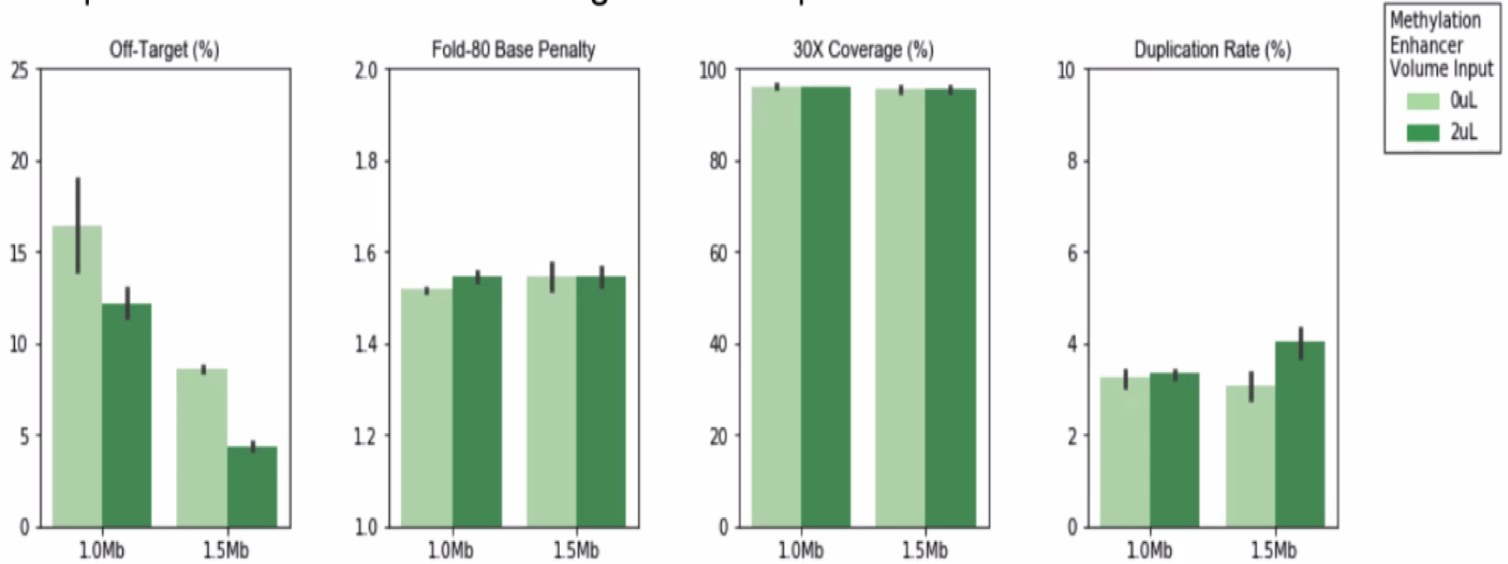
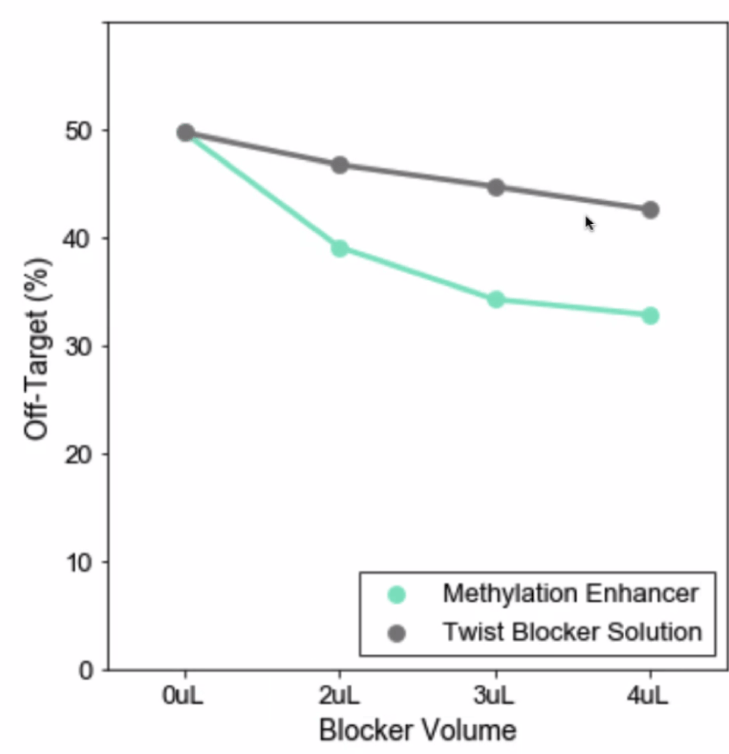
There is no detriment to any hybrid selection metrics when using this reagent. It reduces off-target in a variable fashion depending on custom methylation panel target regions and methylation states of the input genomic DNA. It can potentially decrease 50% in off-target in some custom panels.
See table:
| Panel Size | Custom Panel | Custom Methylation Panel |
| >100 Mb | 5 | 8 |
| 50-100 Mb | 7 | 9 |
| 25-50 Mb | 8 | 10 |
| 10-25 Mb | 8 | 11 |
| 2.5-10 Mb | 9 | 12 |
| 1-2.5 Mb | 9 | 13 |
| 500-1,000 kb | 11 | 14 |
| 100-500 kb | 13 | 15 |
| 50-100 kb | 14 | 16 |
| <50 kb | 15 | 17 |
350 to 450 bp
Twist only supports Mechanical Fragmentation for this application when building libraries to undergo methylation conversion.
We recommend a minimum of 10-20 ng of high-quality DNA and maximum of 200 ng.
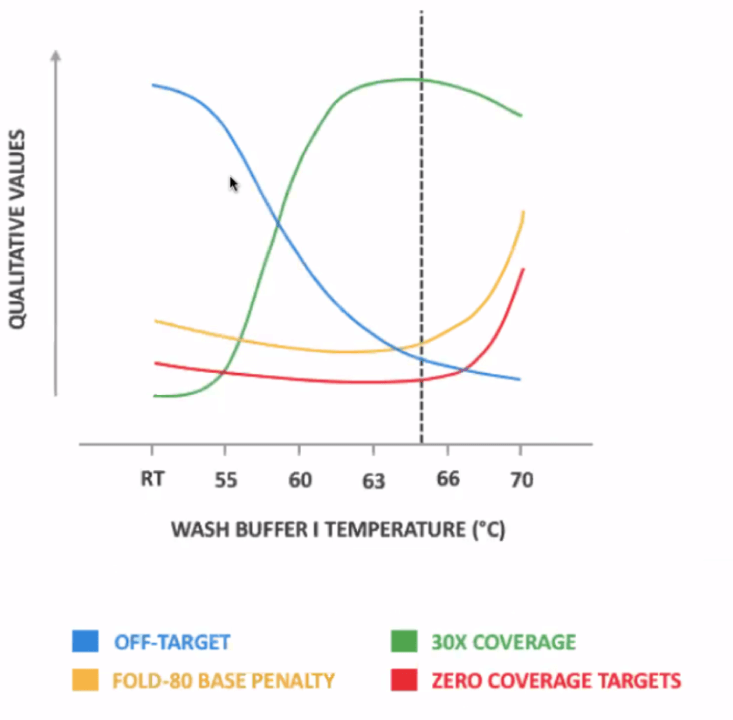
The following can be modified in order to optimize hybrid capture:
- Hybridization time – Start with 2 hours as recommended and modify between 30 min to 4 hours.
- Fast Wash Buffer 1 Temperature – Start with 65°C, adjust between 63-66°C:
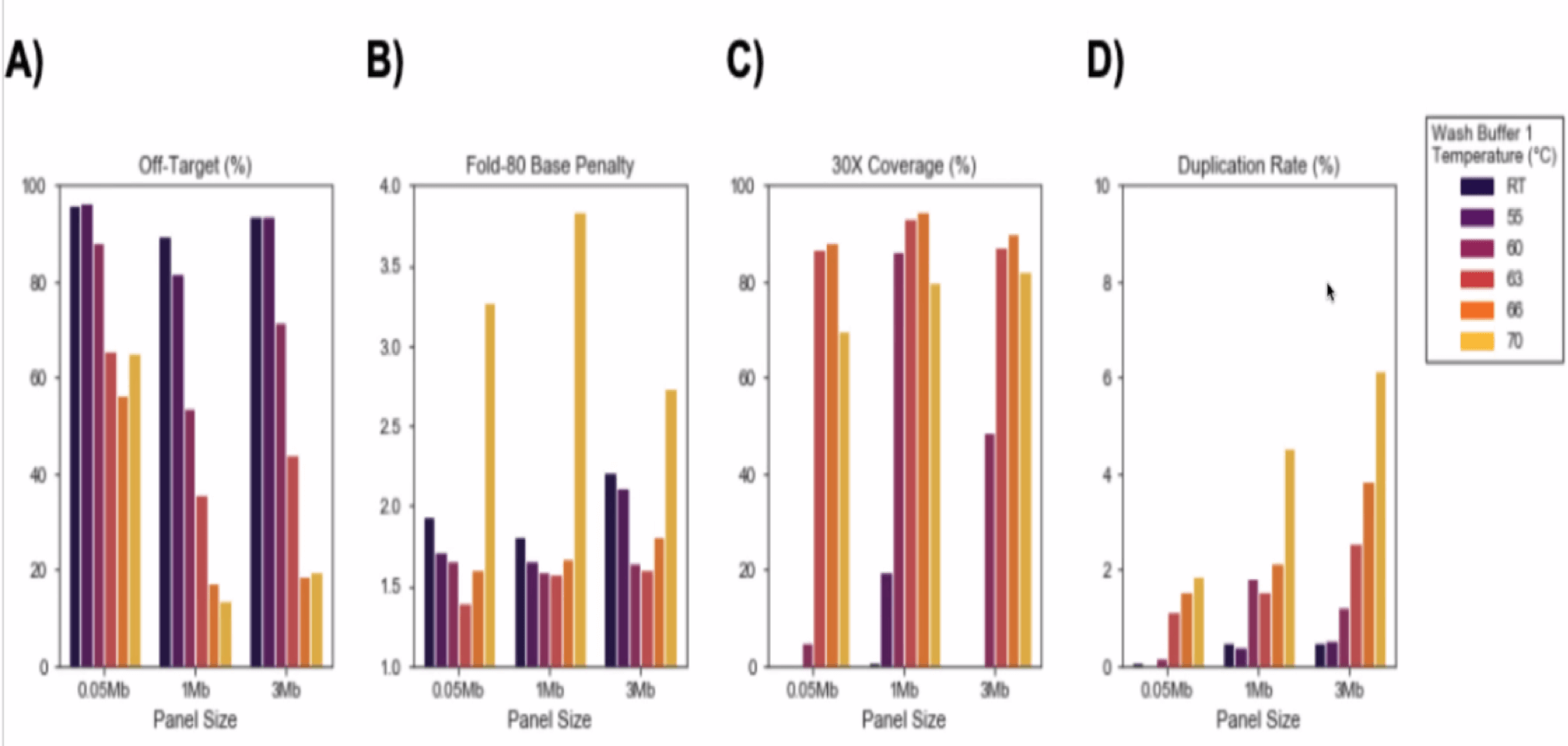
Expected final library yield is between 50-75ng/ul. The yield will depend on the quality of the starting input.
200 to 300 bp
Library Preparation
Yes, Twist adapters are compatible with DNA fragments generated by either enzymatic or mechanical fragmentation.
Yes, the Twist Library Prep kits are suitable to make libraries for whole genome sequencing.
As most WGS applications use longer read lengths (2x151 for Whole Genome Sequencing as opposed to 2x101 or 2x76 for Whole Exome Sequencing), the fragmentation conditions need to be changed to accommodate longer fragment lengths.
For the Enzymatic Fragmentation kits, length is dependent on three factors: Time, Temperature, and DNA input.
For Mechanical fragmentation, conditions (time, power, duty factor, and cycles per burst) should to be set to accommodate longer fragment lengths.
Yes, Twist sells NGS kit components to allow for maximum flexibility. You can obtain a complete list of orderable components by logging into your Twist Account. You can order the following components:
Library Prep Components
- PN 100253 – TWIST LIBRARY PREP EF KIT 1, 16 SAMPLES
- PN 100875 – TWIST LIBRARY PREP MF KIT 1, 16 SAMPLES
- PN 100401 – TWIST LIBRARY PREP KIT 2, 16 SAMPLES
- PN 100572 – TWIST LIBRARY PREP EF KIT 1, 96 SAMPLES
- PN 100876 – TWIST LIBRARY PREP MF KIT 1, 96 SAMPLES
- PN 100573 – TWIST LIBRARY PREP KIT 2, 96 SAMPLES
Combinatorial Adapters
- PN 100255 – 16 SAMPLES
Unique Dual Indexed Adapters
- PN 101307 – TWIST UNIVERSAL ADAPTER SYSTEM, 16 SAMPLES
- PN 101308 – TWIST UNIVERSAL ADAPTER SYSTEM, 96 SAMPLES – PLATE A
- PN 101309 – TWIST UNIVERSAL ADAPTER SYSTEM, 96 SAMPLES – PLATE B
- PN 101310 – TWIST UNIVERSAL ADAPTER SYSTEM, 96 SAMPLES – PLATE C
- PN 101311 – TWIST UNIVERSAL ADAPTER SYSTEM, 96 SAMPLES – PLATE D
Blockers
- PN 100856 – TWIST UNIVERSAL BLOCKERS, 2 REACTIONS
- PN 100578 – TWIST UNIVERSAL BLOCKERS, 12 REACTIONS
- PN 100767 – TWIST UNIVERSAL BLOCKERS, 96 REACTIONS
*Hybridization Reagents
- PN 101263 – HYBRIDIZATION REAGENTS, 2 REACTIONS
- PN 100930 – HYBRIDIZATION REAGENTS, 12 REACTIONS
- PN 100982 – HYBRIDIZATION REAGENTS, 96 REACTIONS
*Fast Hybridization Reagents
- PN 101260 – FAST HYBRIDIZATION REAGENTS, 2 REACTIONS
- PN 100964 – FAST HYBRIDIZATION REAGENTS, 12 REACTIONS
- PN 100968 – FAST HYBRIDIZATION REAGENTS, 96 REACTIONS
*Wash Buffers
- PN 101264 – WASH BUFFERS, 2 REACTIONS
- PN 100985 – WASH BUFFERS, 12 REACTIONS
- PN 100846 – WASH BUFFERS, 96 REACTIONS
*Fast Wash Buffers
- PN 101261 – FAST WASH BUFFERS, 2 REACTIONS
- PN 100971 – FAST WASH BUFFERS, 12 REACTIONS
- PN 100972 – FAST WASH BUFFERS, 96 REACTIONS
Purification and Binding Beads
- PN 101262 – PURIFICATION AND STREPTAVIDIN BEADS, 2 REACTIONS
- PN 100983 – PURIFICATION AND STREPTAVIDIN BEADS, 12 REACTIONS
- PN 100984 – PURIFICATION AND STREPTAVIDIN BEADS, 96 REACTIONS
*Note: Standard Hybridization reagents should only be used with Standard Wash Buffers; conversely, Fast Hybridization reagents should only be used with Fast Wash Buffers. Mixing Standard Hybridization and Fast Wash Buffers (and vice versa) will result in poor performance.
Yes, in addition to our Mechanical Fragmentation kits, Twist also offers the following library preparation kits for use with Enzymatic Fragmentation:
100253: Twist Library Preparation Kit, Enzymatic Fragmentation, 16 Samples (includes enzymes and buffers)
101059: Twist Library Preparation Kit, Enzymatic Fragmentation, 16 Samples (includes enzymes, buffers, and purification beads)
100572: Twist Library Preparation Kit, Enzymatic Fragmentation, 96 Samples (includes enzymes and buffers)
101058: Twist Library Preparation Kit, Enzymatic Fragmentation, 96 Samples (includes enzymes, buffers, and purification beads)
Note for library preparation, you will also need adapters:
101307: Twist Universal Adapter System, 16 Samples
101308: Twist Universal Adapter System, 96 Samples – Plate A
101309: Twist Universal Adapter System, 96 Samples – Plate B
101310: Twist Universal Adapter System, 96 Samples – Plate C
101311: Twist Universal Adapter System, 96 Samples – Plate D
Yes, in addition to our Enzymatic Fragmentation kits, Twist also offers the following library preparation kits for use with Mechanical Fragmentation:
100875: Twist Library Preparation Kit, Mechanical Fragmentation, 16 Samples (includes enzymes and buffers)
101280: Twist Library Preparation Kit, Mechanical Fragmentation, 16 Samples (includes enzymes, buffers, and purification beads)
100876: Twist Library Preparation Kit, Mechanical Fragmentation, 96 Samples (includes enzymes and buffers)
101281: Twist Library Preparation Kit, Mechanical Fragmentation, 96 Samples (includes enzymes, buffers, and purification beads)
Note for library preparation, you will also need adapters:
101307: Twist Universal Adapter System, 16 Samples
101308: Twist Universal Adapter System, 96 Samples – Plate A
101309: Twist Universal Adapter System, 96 Samples – Plate B
101310: Twist Universal Adapter System, 96 Samples – Plate C
101311: Twist Universal Adapter System, 96 Samples – Plate D
The recommended average target fragment size is 200 bp; this will result in an average library size of approximately 350 bp; however, you should adjust your insert size according to your sequencing read lengths.
Twist offers complete* kits for both Enzymatic Fragmentation and Mechanical Fragmentation - note these kits do not include an enrichment panel:
Enzymatic Fragmentation
- PN 101897 – TWIST EF LIBRARY PREP + UDI AND STANDARD HYB, 16x2 REACTIONS
- PN 101896 – TWIST EF LIBRARY PREP + UDI AND FAST HYB, 16x2 REACTIONS
- PN 101901 – TWIST EF LIBRARY PREP + UDI AND STANDARD HYB, 96x12 REACTIONS
- PN 101900 – TWIST EF LIBRARY PREP + UDI AND FAST HYB, 96x12 REACTIONS
Mechanical Fragmentation
- PN 101899 – TWIST MF LIBRARY PREP + UDI AND STANDARD HYB, 16x2 REACTIONS
- PN 101898 – TWIST MF LIBRARY PREP + UDI AND FAST HYB, 16x2 REACTIONS
- PN 101903 – TWIST MF LIBRARY PREP + UDI AND STANDARD HYB, 96x12 REACTIONS
- PN 101902 – TWIST MF LIBRARY PREP + UDI AND FAST HYB, 96x12 REACTIONS
* Note: you must purchase KAPA® HiFi HotStart ReadyMix (Kapa Biosystems®, #KK2601) or its equivalent to generate and amplify libraries.
Assuming an input of 50 ng of DNA, the ratio of adapter to DNA is approximately 200:1.
General
Yes, they are the same beads, just different fill volumes.
For combinatorial and unique dual index adapters, the following sequences are used for adapter trimming: Read 1: AGATCGGAAGAGCACACGTCTGAACTCCAGTCA Read 2: AGATCGGAAGAGCGTCGTGTAGGGAAAGAGTGT
Twist Bioscience guarantees kits for a minimum of 3 months from the date of shipment.
Safety Data Sheets can be downloaded from our web page, here.
Note that we only have SDS documents for NGS products on our web page; for SDS documents for our Synthetic Biology products, please email us at customersupport@twistbioscience.com.
Target Enrichment
Twist Universal Blockers are compatible with TruSeq®-style library kits from Illumina® with single and dual-indexing schemes, and various barcode/UMI lengths. For more information, download the Product Sheet for our Universal Blockers.
We recommend a maximum input of 4 ug of DNA for hybridization. Adding more DNA may reduce the efficiency of the blockers which would result in higher off-target reads.
The sequences of the Post-capture amplification primers in the NGS kit are:
P5 Primer: AATGATACGGCGACCACCGA
P7 Primer: CAAGCAGAAGACGGCATACGA
The concentration of our primers is 10uM for each primer. The final primer concentration is 0.5uM in post-capture PCR.
Twist TrueAmp Polymerase Mix
A hotstart aptamer works by forming a secondary structure at low temperatures (like RT or during setup on the benchtop). This secondary structure binds to the polymerase enzyme and inactivates the enzymatic activity. At higher temperatures (like during PCR thermalcycling) the aptamer’s secondary structure becomes denatured and releases hold of the enzyme.
As part of our QC process we integrate a 10 hour incubation hold at 37 degree C to ensure low temperature setup does not affect performance.
The Twist TrueAmp Polymerase Mix is compatible with a broad range of sample types and is designed to work with a variety of genomic inputs common in NGS research namely purified genomic DNA (gDNA), cell-free DNA (cfDNA) and Formalin-Fixed Paraffin- Embedded (FFPE) DNA.
The new Twist TrueAmp Polymerase mix is engineered and optimized for high yield and robust performance which allows it to efficiently amplify both low-input DNA down to 100 fg and standard inputs, providing a single, reliable solution across diverse sample types.
The Twist TrueAmp Polymerase Mix is for research use only.
We have demonstrated long-read sequencing performance comparable to current market leading polymerases and can be used as a drop-in replacement, but we are now pivoting our development to specialize exclusively in high-fidelity long-read solutions.
The Twist TrueAmp Polymerase mix is shipped and should be stored at –20°C.
Twist TrueAmp Polymerase Mix is rated for up to 20 freeze/thaw cycles with no change in performance. The mix is stable for 2 years.
Twist cfDNA LP and Hyb Mix Kit
The cfDNA Library Preparation Kit is shipped with dry ice and is to be stored between -25°C and -15°C upon receipt.
Still have questions? Contact us
Learn more about NGS Kits
Lorem ipsum dolor sit amet, consectetur adipiscing elit. Suspendisse varius enim in eros elementum tristique.