



 Genes
Genes
 Oligo Pools
 NGS
NGS
 Variant Libraries
 Antibodies
 IVDR Solutions










Get the latest by subscribing to our blog
MRD changed the question
As cancer research technology advances, scientists and clinical researchers are moving beyond the challenge of determining “Can cancer be detected?” to ask a new question: “What is the lowest level of cancer that can be detected?”
Historically, cancer diagnosis relied on imaging to detect cancer, requiring tumors to be physically large enough to detect, limiting imaging utility1. Today, because we know that cancerous tumors shed small pieces of genetic material called circulating tumor DNA (ctDNA), advanced tests called liquid biopsies can detect cancer at very early stages from a blood sample before it is detectable on a standard imaging test¹.
Molecular residual disease (MRD) is any microscopic trace of cancer including ctDNA that remains in the body during and after cancer treatment. Detection of ctDNA through advanced testing opens up a viable path to detect whether treatment is complete and the cancer eradicated, and separately, following treatment, can confirm recurrence of the cancer at a very early stage prior to being palpable or identified through imaging.
When considering what can be achieved in cancer research, there are five things the MRD research field got right when detecting disease.
5 things MRD got right
- Look for molecular signal, not just visible disease
- Tailor the targeted markers to each specific case
- Track more targets when the signal gets smaller
- Match the technology to the biology
- Treat time as part of assay performance
1. MRD got right: Look for molecular signal, not visible disease
MRD researchers understand that residual disease can exist below the resolution of conventional imaging. Imaging detects physical and structural changes, physical tumors that can be seen in the body. ctDNA provides a molecular signal that can be detected without imaging, when the tumor burden is too low, or the amount of cancer is too small to be detected by imaging¹. When cancer can be sensed without seeing it, the focus of detection shifts to maximizing sensitivity to the molecular signal.
The smaller the disease burden, the more important the molecular signal.
2. MRD got right: Know what to look for
ctDNA’s molecular signal is typically found through sequencing, and not all sequencing targets are equally informative. The two primary genomic approaches to detecting MRD are tumor-informed MRD testing and tumor-naive MRD testing. Tumor-informed approaches use information from the tumor sample to identify specific variants of that particular tumor that can subsequently be tracked in blood. Whole genome sequencing (WGS) or whole exome sequencing (WES) of the individual tumor establishes a genomic profile containing genetic variants whereby the tumor can be identified. Tracking these tumor-specific variants, or mutations, makes the search much more precise than looking across predefined genomic regions, and has been shown to increase sensitivity of a test.
Alternatively, tumor-naive, or tumor-agnostic, approaches use the same panel of mutations across all samples. Using an off-the-shelf, or fixed, panel design may save time and money, but at the cost of personalization. When there is no personalization, only a subset of the panel will be relevant to any given sample. With fewer relevant targets, the ctDNA may be more difficult to detect2.
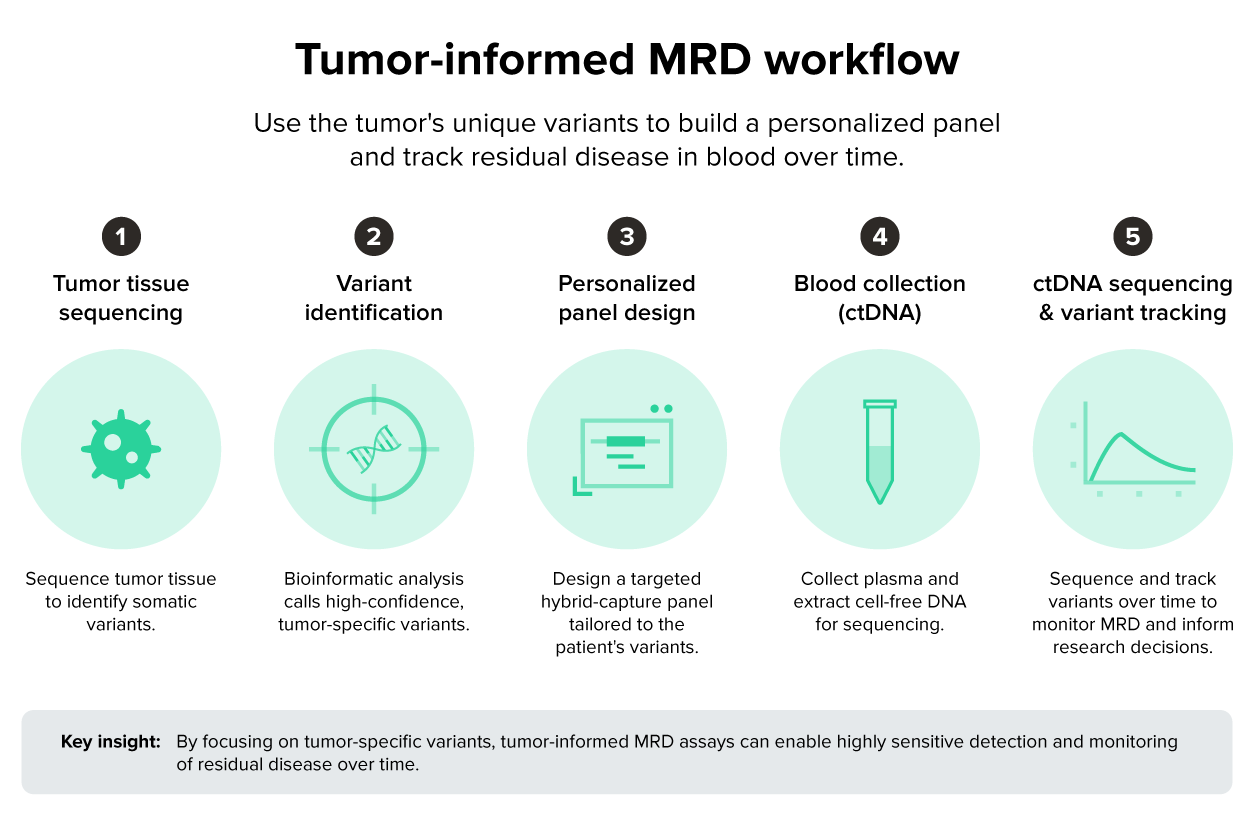
When the signal is rare, knowing where to look matters.
Compare tumor-informed and tumor-naïve MRD approaches
3. MRD got right: More targets can mean more opportunities to find a signal
Tumor fraction is the percentage of cancer-derived material in a sample. At very low tumor fractions, detection becomes a statistics problem as much as a sequencing problem. When tumor fraction is low, very few ctDNA molecules are circulating. Fewer ctDNA molecules means fewer opportunities to find a variant associated with the cancer, increasing the importance of targeting the right variants.
Clonal hematopoiesis is a natural process that occurs as people age. It involves the accumulation of somatic mutations in hematopoietic stem cells that result in their clonal expansion. These mutations are a confounding factor for liquid biopsy research because they contribute background noise to sequencing results. Increasing the number of variants monitored in liquid biopsy samples can combat this noise. Some variants will get lost in the noise, but monitoring more variants supports a robust limit of detection (LoD, the lowest signal that can be observed) over time3.
Imagine each personalized variant as another place where a ctDNA molecule can be detected. As the number of molecules falls, increasing the number of variants increases panel breadth and gives the assay more opportunities to capture the remaining signal. A panel with sufficient breadth of variant coverage increases variant sensitivity and lowers the LoD. Increasing the number of variants sequenced also increases the odds of detecting MRD4.
When the signal gets faint, breadth can become a sensitivity lever.
See how tumor fraction, target count, and sensitivity interact
4. MRD got right: Technology fits the biology
After choosing how to detect MRD (with sequencing) and your list of targets, a workflow must be chosen. There isn't one universally optimal MRD workflow. The right workflow can depend on many factors, including the type of cancer being studied, the tissue affected and its availability, how many mutations are present in the tumor (mutational burden), how many of those mutations are informative to cancer detection, and tumor heterogeneity (how different tumor cells are from each other).
The main two approaches to MRD sequencing are hybridization capture and amplicon (PCR-based) sequencing. Hybridization capture uses sequences (called probes) designed to be complementary to your target sequences. The probes bind directly to the targets so that the untargeted molecules can be washed away, leaving only the targets to be sequenced. Amplicon sequencing uses PCR primers to bind to the flanking regions of the target. Amplicon sequencing can be a better choice when the target list is relatively small, but amplicon and primer design can be hard to scale. Because hybridization capture probes can be designed for specific variants, it has much broader target flexibility and a large number of targets can be designed for the sample, making it easier to monitor a larger marker set. Hybrid capture is a better choice for personalized panel design and is best when tracking many variants5. For personalized, high-target-count panels, that flexibility is the deciding factor.
The right technology depends on what you're trying to detect and the biology you're working with.
Compare hybrid capture and amplicon approaches for MRD research
5. MRD got right: Time is part of sensitivity
Even when you know what you’re looking for, and you have an appropriate target list with the right technology, your experiments will be ineffective if they take too long. An assay can be analytically sensitive and still be poorly suited to a research decision if the result arrives too late. MRD research often follows ctDNA levels over time within a study, to understand treatment response and disease recurrence patterns across a research cohort. Often, studies evaluate the adjuvant therapy window, the amount of time after initial cancer treatment before a follow-up therapy can kill residual cancer cells successfully in translational research cohorts. These results are time sensitive. How soon the results are available can make or break how valuable they are. A result that arrives after the decision window has closed may be scientifically valid, but operationally too late to inform the next step6.
Sensitivity isn't just how faint a signal you can detect. It's whether you can detect it when the result matters.
Explore why speed, sensitivity, target count, and chemistry all matter in MRD research
See how MRD Express is designed to shorten the path from personalized panel design to sequencing
What MRD got right and where the field goes next
MRD got five fundamental things right:
- Disease can leave a molecular footprint before it becomes visible.
- Personalized targets can make that footprint easier to find.
- Broader target sets can create more opportunities to detect extremely low-frequency signals.
- Assay technology needs to fit the biology and research question.
- A result only has value if it arrives within the window when researchers can act on it.
Rather than sequencing deeper to make MRD tests more sensitive, we now need to focus on preserving sensitivity while making personalized MRD research faster, scalable, and adaptable to the biology being studied.
Explore the science and technology behind MRD research
Explore personalized MRD panels
References
- Pulumati A, Pulumati A, Dwarakanath BS, Verma A, Papineni RVL. Technological advancements in cancer diagnostics: Improvements and limitations. Cancer Reports. 2023; 6(2):e1764. doi:10.1002/cnr2.1764
Jonathan Baden et al. Generic Protocols for Analytical Validation of Tumor-Informed Circulating Tumor DNA Assays for Molecular Residual Disease: The Blood Profiling Atlas in Cancer's Molecular Residual Disease Analytical Validation Working Group Consensus Recommendation. JCO Precis Oncol 10, e2500267(2026). DOI:10.1200/PO-25-00267
Chan HT, Chin YM, Nakamura Y, Low SK. Clonal Hematopoiesis in Liquid Biopsy: From Biological Noise to Valuable Clinical Implications. Cancers (Basel). 2020;12(8):2277. Published 2020 Aug 14. doi:10.3390/cancers12082277
Based on Muzzey, D. Ultra-sensitive molecular residual disease detection with Myriad’s Precise MRD test. Sponsored Industry Expert Theater presentation, ASCO Annual Meeting, Chicago, Illinois, USA (2026). Used with permission.
Singh RR. Target Enrichment Approaches for Next-Generation Sequencing Applications in Oncology. Diagnostics. 2022; 12(7):1539. doi:10.3390/diagnostics12071539
Gillis R, Zahavi T, Peled N, Yaacov A, Afifi B, Salim J, Basheer R, Asna N, Makori A, Peer M, et al. The Impact of Minimal Residual Disease (MRD) Testing on the Decision-Making Process in Non-Small-Cell Lung Cancer (NSCLC). Cancers. 2026; 18(8):1246. doi:10.3390/cancers18081246
Disclaimer: Twist Bioscience products are for Research Use Only. Not for use in diagnostic procedures.
Recommended Resources

Twist Bioscience HQ
681 Gateway Blvd
South San Francisco, CA 94080